

World Cup Mascots: Why Good Design is so Important

Updated: Jun 29

It’s no secret that quality design is a vital part of marketing. It can make or break your outreach in a flash. Whether it’s logos, websites, or advertisements, quality design work engages your audience immediately, while poor executions have the opposite effect.
We wanted a clear way to show how important design is to your branding strategy. So, with the 2026 World Cup underway, we’ve dived into the world of mascot design, exploring the good, the bad, and the downright ugly mascots across the tournament's history.
We focus on the design details that can make a mascot a merchandising goldmine or cautionary tale, from colour choices, cultural/societal contexts, and a deep understanding (or lack thereof) of what audiences actually want.
So, keep reading to see which designs secured legendary marketing success, and which completely missed the back of the net!
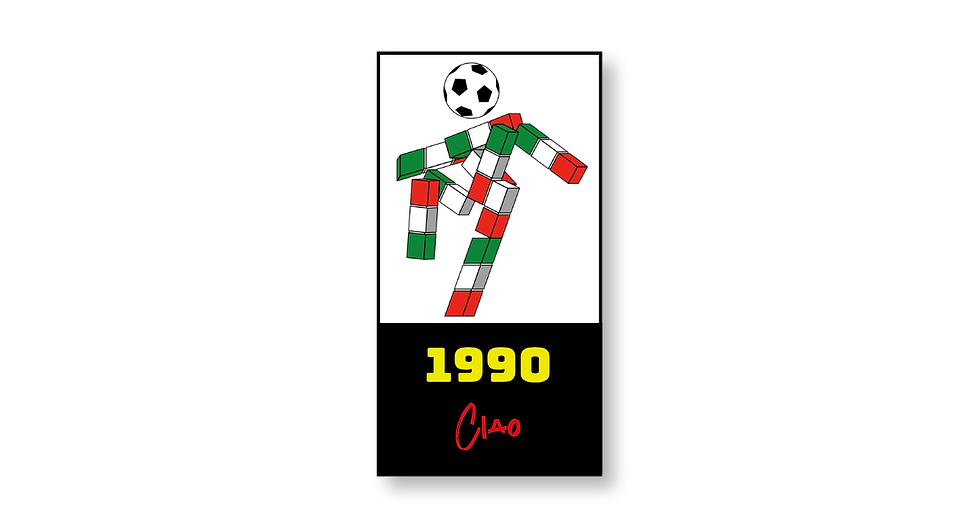
1990 Italy “Ciao” world cup mascots
In 1989, ‘Tetris Mania’ took over the globe after Nintendo bundled it with the release of its new Game Boy console. While worldwide love for the block-stacking puzzle game may explain the inspiration for our 16th-place mascot, it certainly doesn’t excuse it.
“Ciao” is a cuboid stick figure with a football for a head and a design that leans into the puzzling side of Tetris rather than the fun one. He's the only World Cup mascot without a face… though I'm not really sure what to make of that, and it seems many others weren’t too sure either.
It's understandable. Besides using the red, white, and green of Italy’s flag, his design offers little for fans to relate to. It feels like such a missed opportunity that Italy’s iconic cuisine, revolutionary culture, or historic roots aren’t touched on at all. I’m mourning the football-playing Roman Gladiator we could’ve had.
When deconstructed, his design spells out “Italia”, which is a cool addition, but I think for now we’ll say ‘ciao’ and move on.

2022 Qatar “La’eeb”
La’eeb’s design was inspired by the Keffiyeh, the national male headdress, so we completely get the thought behind this one. However, while culturally relevant, Qatar's unique take on a World Cup mascot didn’t land as expected.
FIFA says he is from an “indescribable mascot-verse” (eyeroll) and invites everyone to “intepret what he looks like”. Well, in our interpretation, he looks more like Casper the Friendly Ghost than a serious mascot, with many other fans also mistaking him for a ghoul upon release.
Design-wise, he’s just all-around confusing. I’m not sure who decided that a character without legs or feet would be the perfect football mascot.

2006 Germany “Goleo VI and Pille”
Now, time for another head-scratcher.
“Goleo VI” was a trouserless, life-sized lion designed by the Jim Henson Company for the low, low price of €250,000. Closer to a scruffy stuffed bear than the king of the jungle, his design was clunky and unsettling, with fans overwhelmingly rejecting him.
After spending millions on the exclusive licensing rights to sell “Goleo” plush toys, German toy manufacturer Nici was forced to file for bankruptcy before the games even began. The reason? Fans outright refused to buy anything.
The strangest part here, however, is the decision to choose a lion in the first place, as the animal isn't associated with Germany at all. In fact, it’s far more strongly tied to their historic rivals, England and the Netherlands. The public argued that the mascot should have been an eagle instead, the national bird on Germany's coat of arms.
His sidekick, “Pille”, a talking football, was at least a little more relevant, but really isn't pushing creative boundaries or the duo any higher up this list.

1978 Argentina “Gauchito”
Designed by cartoonist Hugo Casaglia, “Gauchito” is a little boy decked out in the iconic blue-and-white striped Argentinian jersey, with a gaucho hat and whip to pay homage to the iconic 19th-century horsemen. With these cultural references woven into his design, he is a good representation of his nation.
He’s also a little uninspired.
As a child mascot in a huge hat and “-ito” at the end of his name (a Spanish diminutive to make things smaller/cuter), he’s almost a direct rip-off of the Mexican mascot before him. In fact, FIFA was criticised for following the "pudgy, smiling young boy" trope for 3 consecutive World Cups.
On a darker note, the 1978 World Cup took place during Argentina's brutal military dictatorship. His innocent, smiling design was manipulatively used to hide human rights abuses and project a false image of the country to the rest of the world. Yikes.
We like that he's left-footed, bearing a resemblance to future football legend Lionel Messi. Other than that, there's not much more to say.

2002 Korea/Japan “Ato, Kaz, and Nik”
As a 2000’s baby, I appreciate a futuristic, robo-alien character design as much as the next person. As a designer, I believe risk-taking in creative design should be rewarded. These guys embody both, so I really wanted to like them more than I do. Honest!
Unfortunately, they left me more than a little disappointed.
With both Korea's and Japan’s rich animation histories, there was so much potential here. However, their confusing designs carried absolutely zero symbolism related to either country or even the game itself! Coming from the "Atmozone" dimension, Kaz and Nik played "Atmosball," instead of football, with Ato as their coach. Hey, at least they have a backstory.
With names voted for in McDonald's across the host nations (that tracks; they do feel like lost Happy Meal toys), “The Spheriks”, as they were collectively known, flopped internationally.
Western football fans found the vibrant, abstract blobs overly commercialised. I just found their disconcerting smiles kinda creepy.

2026 Canada, Mexico, United States “Maple, Zayu, and Clutch”
You may be somewhat surprised to see our current mascots so far down this list, but I doubt you’ll be too upset.
The trio have overcome the branding hurdles of a multi-host tournament by being 3 distinct members of the same team, each fiercely representing their nation through their values, jersey colour, and species.
While they do get points for the national pride in each design, we can't help but feel like the choices are too predictable. (*as Miranda Priestly* Eagles for America? Groundbreaking.)
For the first time, FIFA designed the mascots with gaming integration in mind, featuring them as playable characters in the ‘FIFA Heroes’ video game. This leads to a glossy, computer-generated look that, while fitting for today's age and perfect for FIFA’s plans, feels a little cold next to earlier 2D mascots.
Also, it doesn't help that these guys were completely outshone by a pet duck named Merlín, known for plodding around in his mini Mexico jersey. He’s become so popular as the game’s "unofficial mascot" that Mexican President Claudia Sheinbaum even welcomed the duck to the National Palace. TLDR: organic online culture always defeats planned corporate branding.

1974 West Germany “Tip and Tap”
“Tip and Tap” are an endearing pair of lads who look like they've stepped right off the pages of a retro comic strip. Rosy cheeks, messy hair, buck teeth: their design is full of '70s charm.
Standing arm in arm in matching jerseys, the boys, as noted by FIFA, project an “image of togetherness and friendship”. Aww.
In post-war Germany, this sense of unity was an intentional design point, with the first-ever mascot duo used to promote geopolitical togetherness, peace, and the potential reunification of East and West Germany.
While we respect the noble intentions, from a designer's POV, “Tip and Tap” feel a bit bland compared to other mascots.
P.S. In case you’re curious, the WM on Tip’s shirt stands for “Weltmeisterschaft”, German for World Cup. The more you know.

2018 Russia “Zabivaka”
“Zabivaka” was a grey wolf designed by a graphic design student and entered into a month-long national poll, where over 1 million Russians voted for him.
We can see why he won.
The design is pretty solid, inspired by an animal that’s already a point of national pride, and drawn with a cute, approachable appearance. The wolf is a prominent figure in Russian folklore, often symbolising speed, cleverness, and assertiveness: perfect qualities for a footballer.
According to FIFA, he “radiates fun, charm, and confidence”, and with a name that means “one who scores”, this confidence is obvious. Russia did net 5 goals in their first match, so maybe Zabivaka was something of a good luck charm.
But why is he not higher on our list? Well, while adored locally, he just didn't take over the public imagination like his predecessors. In the social media age, Zabivaka had to compete with a constant flood of content to remain relevant, so we’ll cut him some slack.
Plus, we know Russia has a cold climate, but there's just something about his design (perhaps his giant ski goggles?) that reads more like the Winter Olympics than the World Cup.

1998 France “Footix”
“Footix”, created by graphic designer Fabrice Pialot, is a shocking blue Gallic rooster, widely considered one of the most commercially successful and iconic mascots in sporting history.
With an eye-catching, clean-lined design inspired by the national symbol of France, Footix was perfect for mass production and was an instant hit on clothing, keychains, and posters. However, he wasn't always so well-received.
When unveiled 2 years prior, Footix was mocked by the French public for his cartoonish, uninspired appearance. It was only after France won that the public embraced him… most likely out of pure victory nostalgia. A lasting consequence of this? The term "Footix" became an insult in French football culture, still used today to refer to fake fans who only care about football during major tournaments.
In more ways than one, he boasts a longevity few mascots achieve. In fact, his character design was so enduring that FIFA successfully introduced "Ettie”, a young chicken and Footix’s daughter, as the official mascot for the 2019 Women's World Cup in France.
In our opinion, his memorability has more to do with the tournament itself (think Michael Owen’s solo wonder-goal, Zidane's two identical first-half headers, Beckham's infamous red card, etc., etc.) than his simplistic design.

1994 United States “Striker”
“Striker” was another mascot voted for by the public, with the American people choosing the domestic dog over an astronaut, a bison, and a bald eagle (oops, sorry, Clutch).
This “World Cup Pup” was designed by the legendary Warner Bro’s. animation team and ironically wouldn't have looked out of place in a Disney film, with his floating ears and slightly smug expression. His classic look was reminiscent of retro Hanna-Barbera cartoons like ‘Huckleberry Hound’, and the public just couldn’t get enough.
Merchandise went through the roof, with Striker's face plastered onto everything from video games to McDonald's Happy Meal toys, clothing, and millions of plush dolls.
Okay, so we can't deny his commercial success.
However, many international soccer critics widely dismissed Striker as uninspired and corporate, and we can’t help but agree. A cartoon dog is somewhat of a lazy, safe choice. Besides being the overwhelming pet of choice for the American public, there’s not much that ties Striker to the nation. Well, except for his love of capitalism. Bad dog.

1970 Mexico “Juanito”
Getting deja vu? (Gauchito, we’re looking at you). Well, this round-faced, adorable child mascot paved the way for the rest.
As the second mascot of the games and the first-ever human mascot, “Juanito” was a design trailblazer, proving that you don't have to rely on animals for marketing success. With his slightly-too-small shirt and aww-worthy smile, it’s easy to see why Junaito sold a ton of merchandise. His comically large feet, which he uses to play with a disproportionately sized ball, only add to his cuteness.
Juanito is hard not to love, but he’s certainly not getting any points for creativity.
1970 marked the first World Cup broadcast in colour, and while his three-tone kit definitely stood out, this exciting milestone could have been met with more than the polite, humble Juanito.

1986 Mexico “Pique”
“Pique”, the anthropomorphic, moustached chilli pepper in an oversized sombrero, certainly broke a stale, decade-long design mould of chubby human children.
Pique’s bright colours popped flawlessly on screens, and, alongside the tournament’s geometric, pre-Hispanic-inspired logo, helped create a visual identity that graphic designers still praise today.
His name is pretty smart, too. Derived from picante, the Spanish word for "spicy," and doubling as a local football term for two players in the heat of a play (¡Qué pique!), it was perfect for this hot-headed tournament, where 8 red cards were handed out (the most the World Cup had ever seen)
While his design is undoubtedly charming and represents Mexico's food culture, he’s perhaps a little more than just crudely drawn. His sleepy eyes, moustache, and baggy clothes play into harmful ‘lazy Mexican’ stereotypes, with one prominent Mexican official publicly blasting the design, calling it "absurd", as if "a group of gringos picked out a symbol to depict Mexico".

2010 South Africa “Zakumi”
Just shy of our top three, “Zakumi” wonderfully represents his country and the game itself.
The Leopard is an iconic savannah animal, and this big cat features hexagons instead of classic spots, mimicking the patches on a football. He perfectly camouflages with the pitch with his spiked green hair, and has a creative name to boot (see what we did there?). “ZA” is the country code for Africa, and “kumi” means 10 in many African languages.
We love how, unlike previous corporate-led designs, Zakumi was built by local creators. The costume was meticulously handcrafted by 'Cora's Costumes', giving South Africans a deep sense of national pride and ownership.
Overall, we like this design, and others did too, with Zakumi getting his own highly rated, multi-million dollar cartoon series of the same name. However, he's docked points for not being memorable enough to outshine what some could consider the true mascot that year: Vuvuzelas.

1966 England “World Cup Willie”
At number 3, we have the one that started it all.
Before 1966, sports tournaments used flags or logos to promote themselves, so the introduction of “World Cup Willie” as a mascot really shook things up. Well, if you consider fundamentally birthing the multi-billion-dollar industry of modern sports licensing to be “shaking things up”.
Looking at Willie from a designer's POV, there’s not much to improve. Strong, striking, and closely tied to English pride and history, a lion was the perfect choice for this mascot. He’s inspired by 'The Three Lions' on the national team's badge, dating back to the 12th century, when the symbol was used on the battlefield to inspire victory.
And boy, did Willie bring many victories: from England's first and only FIFA World Cup trophy after defeating West Germany 4-2, to the millions in revenue (he was licensed for over 100 different products!).
What keeps him from a higher ranking is my preference for a different animal “mascot” that year, Pickles the Border Collie. While out on a walk, he sniffed out the original, solid-gold Jules Rimet trophy that had been stolen a week prior and became a national hero.
His rewards? The title of “Dog of the Year”, a silver medal from the National Canine Defence League, a year's supply of free dog food, a starring role in the British comedy ‘The Spy with a Cold Nose’, and the chance to lick the players' dinner plates clean at the grand celebration banquet.

2014 Brazil “Fuleco”
Over 90% of the Brazilian public agreed that the 2014 tournament needed to be environmentally friendly, so Brazil set out their goal to host the “greenest ever” sporting event in human history. From this desire, "Fuleco" was born.
With his highly praised, punny name combining the Portuguese words for football (Futebol) and ecology (Ecologia), this three-banded armadillo (a native animal only found in Brazil and that was endangered at the time) felt like a great choice.
This blue, green, and yellow powerhouse perfectly mirrored the colours of the Brazilian flag, but that's not the end of his thoughtful design choices. With strong scales to emphasise Brazil’s dedication to protecting its natural features, we love the nature-first direction of this mascot.
On a personal level, I’ve placed him so highly because he’s bright-eyed, brightly coloured, and it’s such a bright idea to have an animal that can turn itself into a ball be a World Cup mascot.
On a pragmatic level, he misses out on the top spot because FIFA failed to match this "ecological" branding with actual, real-world funding. If you need a textbook example of corporate greenwashing, look no further.

1982 Spain “Naranjito”
And finally, taking the top spot: “Naranjito”!
I’m self-aware enough to note that I may have a slight bias towards food-themed marketing (hi, we’re Butter Popcorn), but this lovable, wobbly-smiled orange steals my heart.
He was the first of the edible mascots, coming 4 years before Pique, and brought a fresh perspective to mascot design, inspired by the famous citrus fruits of the country's Mediterranean regions, like Valencia and Murcia.
This World Cup took place as the host country transitioned from a dictatorship to a modern democracy, so his wide-eyed grin and bright orange colour came to symbolise the optimism of a newly free Spain.
While at first he was widely mocked by the Spanish public as an out-of-shape joke masquerading as a national symbol, his reputation was saved by a stroke of marketing genius.
Broadcaster RTVE produced a full-length animated television series called Fútbol en acción (Football in Action) starring Naranjito and an array of other citrusy friends. After that, the mascot was solidified as a beloved pop-culture icon of the 1980’s.
And that’s a wrap! From legendary triumphs to absolute flops, this ranking shows that great design is the best way for a brand to truly connect with its audience. To stand out in today’s oversaturated market, you need visuals that actually hook people and drive real results. At Butter Popcorn Productions, that’s one of the things we do best. Want to ensure your next branding project is a total win? Get in touch with us today, and let's create something memorable together.


Comments